Podcast
Withstanding Podcast Season 5

Withstanding returns with a new season!
The fifth season of FCINY’s podcast focuses on highlighting Finnish artists research, work and exhibitions in New York. This program is made possible with support from the Finnish Ministry of Education and Culture and the New York State Council on the Arts.
Envisioning a brighter future, Withstanding continues to bring together art professionals from both sides of the Atlantic to share and speculate, care and criticize, and to dream of more just and sustainable conditions for artists and art practitioners at large.
Make sure to check out also season 4, season 3, season 2 and season 1 of the podcast.
Listen to Withstanding on Youtube, Apple podcasts, Spotify, or Soundcloud.
EPISODE 19: Ergonomics for the Mind: Ida Kukkapuro and Michael Yarisnky on Yrjö Kukkapuro’s Design Philosophy
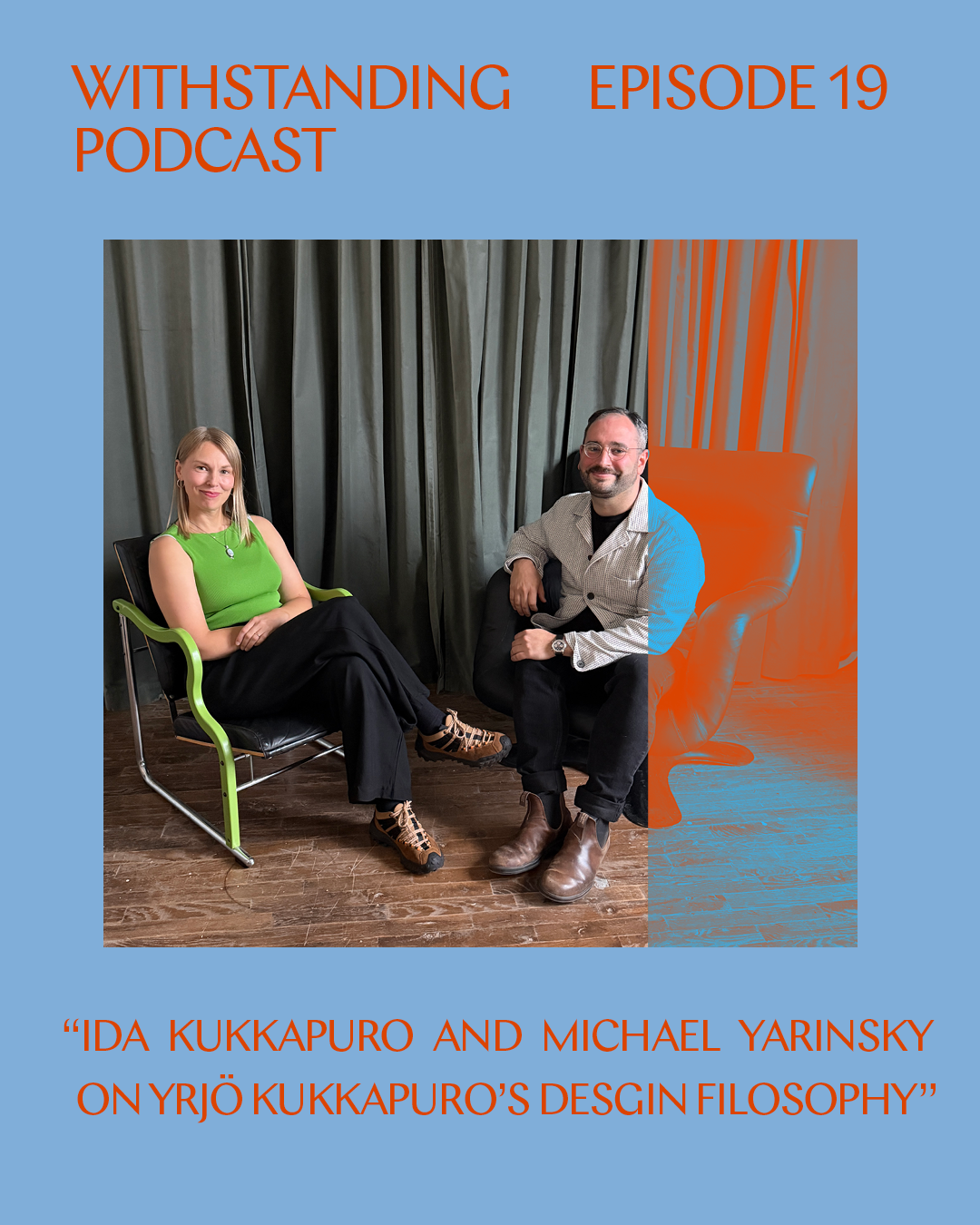
In the fifth episode of Withstanding, season 5, designer-in-residence Ida Kukkapuro joins Michael Yarinsky, co-founder of Office of Tangible Space, to talk about her grandfather, designer Yrjö Kukkapuro, Studio Kukkapuro, and the continued relevance of his design philosophy today. The two are at the Office of Tangible Space, surrounded by Kukkapuro’s designs: Ida is sitting in the Experiment chair, designed by her grandfather in the 1980s, while Michael is sitting in the Carousel chair from the 1960s.
Ida, who describes herself primarily as a journalist rather than a designer, and Michael, an architect and multidisciplinary designer, discuss why Kukkapuro’s work continues to resonate in New York and what Finnish design means as part of everyday life. They also turn to the principles that shaped Kukkapuro’s work, from ergonomics and human-centred design to ecological and social responsibility.
For Michael, Kukkapuro’s work has been a reference point for his own practice for a long time. What makes Kukkapuro’s work particularly relevant to him is the combination of personality and functionality. His furniture has a distinct visual character, but it is also driven by human considerations, particularly ergonomics and feeling. The two discuss how Kukkapuro designed these objects over a time span of more than seven decades, reflecting a significant expertise developed across changing design trends. Individual pieces could take years to develop; the Carousel chair, for example, was the result of a long and meticulous process.
The conversation then moves to Finnish design more broadly. Michael describes design as deeply embedded in Finnish society. For Finns design is “almost like waving a Finnish flag.”
Ida mentions that Aalto and Kukkapuro chairs have been part of Finns’ lives since childhood, found in Finnish kindergartens, schools and libraries. What may appear remarkable from outside Finland can therefore feel completely ordinary to someone who grew up surrounded by it. This everyday familiarity also connects to the way Ida describes good ergonomics in Kukkapuro’s work. She points out how difficult it can be to explain why a fork feels good in the hand or why a chair feels good to sit in. When ergonomics work properly, the design can become almost invisible.
Later, ecological and social responsibility became increasingly important design principles for Kukkapuro. His furniture was designed to be repairable, with replaceable upholstery and accessible components. Aesthetic considerations came alongside these practical ones: Kukkapuro described aesthetics as “ergonomics for the mind.”
The conversation eventually turns to what happens next. Studio Kukkapuro is continuing to work with Yrjö Kukkapuro’s legacy, with plans to open the studio to visitors on a limited basis in summer 2027.
There are also longer-term plans to turn the house into a museum. For Michael, the importance of the future museum is not only about preserving Kukkapuro’s work. His furniture and the house together offer a way of understanding both how Kukkapuro’s thinking developed and how Finnish society changed around him.
Kukkapuro’s rural upbringing in Eastern Finland can be traced in the home he later designed for himself and his family: a single-room, parabolic structure for living, working, building furniture and reading. For Michael, the studio echoes the farmhouse Yrjö Kukkapuro grew up in. The house and his body of work offer a material record of modern Finland, spanning the development of the welfare state and changes from the 1950s to the 2020s. For Michael, this is also what makes Kukkapuro’s work timeless.
The next chapter of Studio Kukkapuro is therefore about finding new ways to make this work accessible. By opening the studio and eventually the home to visitors, Ida and her family can bring Kukkapuro’s work to new audiences, including outside of Finland. The archive will be an important resource for contemporary and future designers.
Ida Kukkapuro is a Helsinki-based writer, broadcaster and director. She directs Studio Kukkapuro, an initiative preserving and expanding the legacy of designer Yrjö Kukkapuro and artist Irmeli Kukkapuro. Her work focuses on design, architecture, urban environments and cultural heritage. She has hosted and researched programmes for YLE and Radio Helsinki and writes for publications including The Guardian, Apartamento and Helsingin Sanomat.
Michael Yarinsky is an interdisciplinary designer and architect working across architecture, interiors and furniture. His practice explores how modernism can be made more material, textured and emotionally engaging through unexpected materials, technologies, forms and colours.
He studied architecture at Pratt Institute and is the co-founder of Office of Tangible Space. He also founded Cooler Gallery, co-runs Design Field Trip and the seminar People in Places, and is a Fellow of the Urban Design Forum.
EPISODE 18: On creating outside the boxes of categorization and social norms
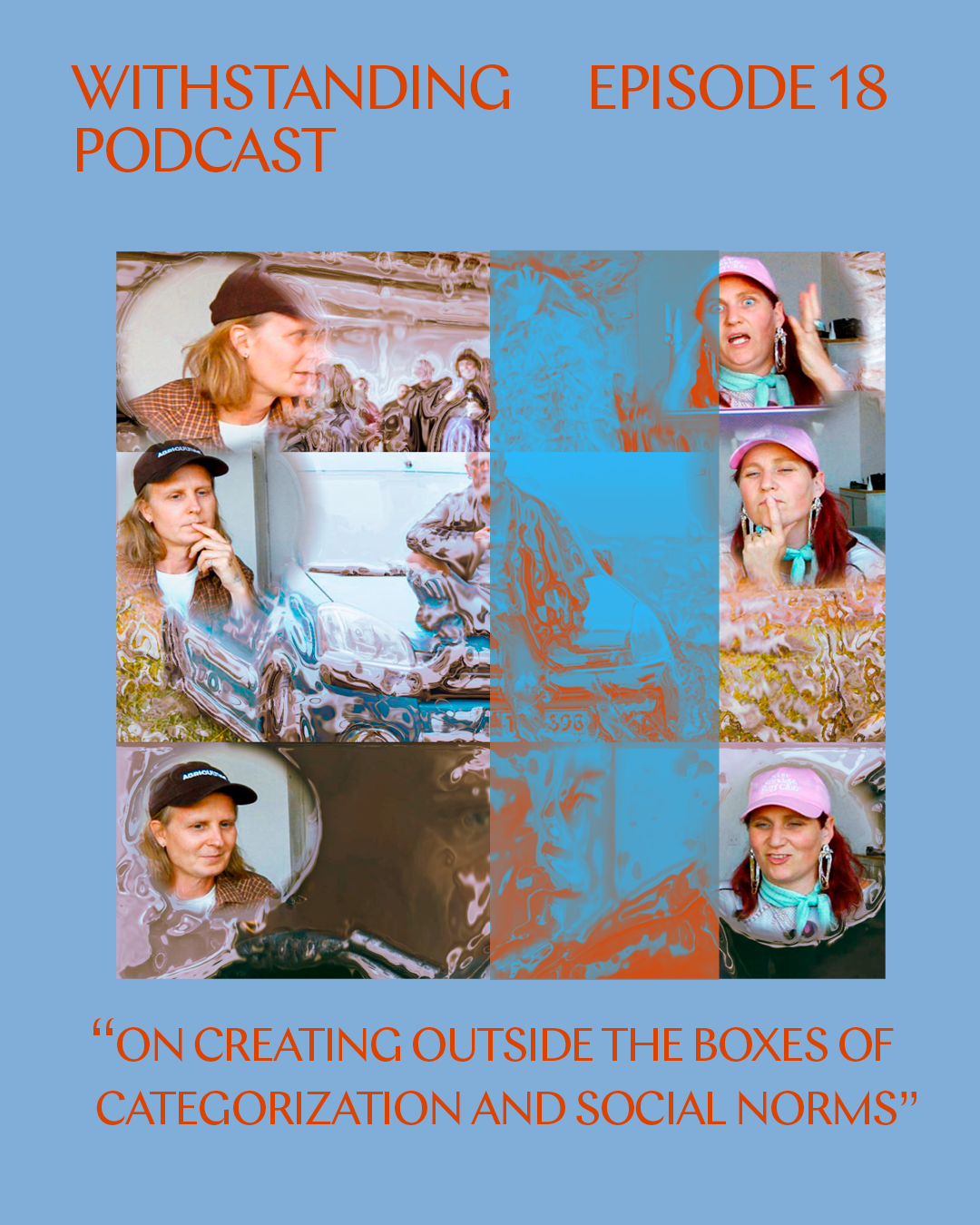
On the fourth episode of Withstanding Podcast Season 5, artist Jade Kallio and Mette Sterre are joined in a discussion recorded during their overlapping residencies at the International Studio & Curatorial Program (ISCP) in New York. Although they primarily work in different media and artistic practices, they quickly recognized a shared set of concerns and similarities that run through both of their practices. Creating outside of the boxes of how we understand identity, gender, technology, society norms and the body.
Throughout the conversation, Kallio and Sterre reflect on the role of categorization, why we rely on it, how it structures our social and political realities, and what artistic practice can offer as an alternative. Rather than proposing new fixed identities, both artists are interested in creating spaces where contradiction, and transformation can exist without resolution.
This episode is infused with humor, as this is something Both Kallio and Sterre uses as a tool and strategy when creating. They talk about how it’s not simply used as relief or entertainment, but as a method for disrupting familiar ways of thinking, exposing invisible structures, and opening unexpected pathways through complex subjects.
The artists also discuss the projects they are developing during their residencies. Kallio speaks about their evolving work Workwear, a long-term project that began in New York, where they learned to sew underwear and has expanded into a reflection on labour, institutional systems, gender, family history, and industrial production. Sterre, meanwhile, describes her ongoing research into Coney Island, a historic seaside neighborhood and amusement district in Brooklyn. Across these different paths, both artists reveal a commitment to speculative thinking, where materials, bodies, and narratives become tools for imagining other ways of inhabiting and living the world.
In the second half of the episode, the conversation shifts from process to practice as the artists watch and respond to selections from each other's work. Kallio's films and Sterre's performances. Their observations offer an intimate glimpse into how they read one another's artistic languages, drawing connections between recurring motifs, methods, and questions.
Jade Kallio is a Helsinki-based filmmaker and artist whose practice reflects on gender, corporeality, and the spaces and social structures in which meanings are produced, with a focus on trans identities and marginalized experiences. Kallio explores how social norms shape possibilities for existence and visibility. Current projects blend documentary, speculative fiction, and magical realism while considering production structures, working conditions, and questions of narrative authority. Kallio has exhibited work at International Short Film Festival Oberhausen, Germany; The Centre for Contemporary Art, Ireland; and International Film Festival Rotterdam, The Netherlands, among others.
Beyond performance, Mette Sterre’s universes transcend into digital technologies, speculative environments, and sculptural body masks. Sterre imagines what else we could be by materially and ideologically upending the human contour. In these contexts, bodies and stories not only highlight their limitations but also show how much can be revealed in the process of being in change. Playful and captivating, their art poses concerns about knowledge, control, or systemic forces.
Mette Sterre has exhibited work at Manifesta 14 Prishtina, Amsterdam; Museum Of Modern and Contemporary Art Changdong, Seoul; and The Watermill Center, New York, among others.
Episode 17: On hypnosis and cognitive art as a space of simulation
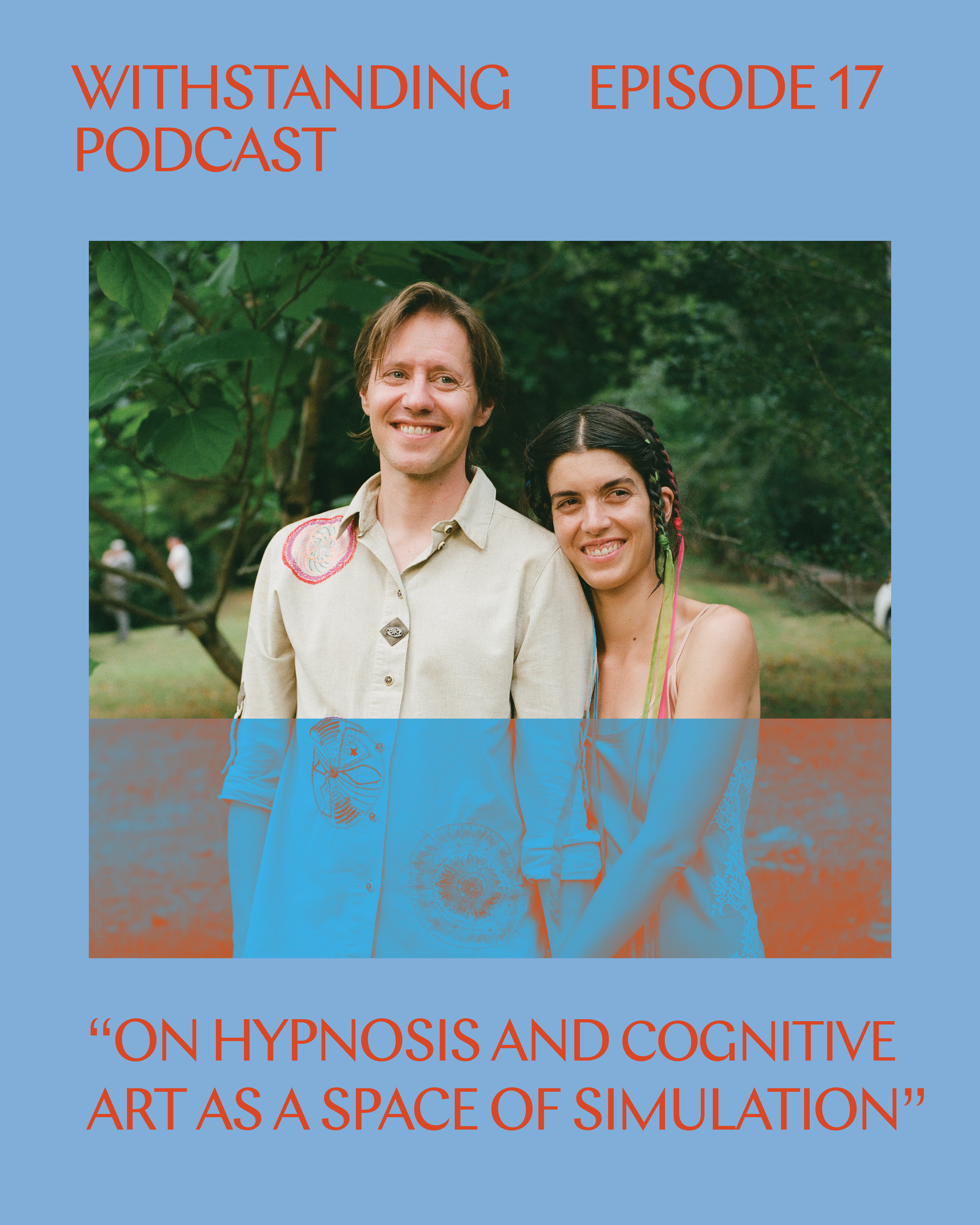
Artists Aapo Nikkanen and Flora Bouteille by Osma Harvilahti.
On the third episode of Withstanding Podcast Season 5, artist and certified hypnotherapist Aapo Nikkanen is joined by artist and educator Flora Bouteille for an intimate conversation about the worlds that we can build with art.
Working around the same themes in their practices, the artist couple explores the intersections of hypnosis, simulation, and cognitive artistic practices in performance and photography. The intimate conversation moves from the history of hypnosis through framing cognitive art to a broader question: what is the future of art in a world where everything seems possible?
When we experience art, we often enter a temporary shift in perception. Art can take us to a space where emotions and meanings find new perspectives. As Aapo Nikkanen frames it, hypnosis operates in a similar yet more immediate way: rather than representing an alternative reality, hypnosis induces a focused state of attention in which imagined scenarios are experienced as real.
Performance art, rather than imitating life, reframes it. As theorists such as Richard Schechner suggest, performance creates structured situations that reveal aspects of reality through framing and repetition. Performance art produces a “space within a space” – not a literal simulation, but a heightened condition of perception.
When combining performance art and hypnosis, the performance happens mostly in participants' minds, creating a simulative space. Hypnosis in art can function as a site of testing: a space where perception can be rehearsed, interrupted, and reoriented. A way of encountering reality differently.
Both Nikkanen and Bouteille challenge the idea of art as a closed, autonomous field. When specialized methods such as coding, AI systems, or simulation frameworks become increasingly accessible, artists are no longer limited to traditional mediums. Instead, they can engage directly with the infrastructures shaping contemporary life. This moment opens a possibility to work within the technological change, repurposing its methods critically and imaginatively.
So, what emerges when these three simulative elements, art, hypnosis, and AI intersect in their interest in how reality is experienced? Together, these practices suggest a shift from representing reality to actively shaping how it is perceived.
Within this context, the conversation turns toward a broader question: should art be only art?
Watch and listen to the episode to learn how the artists approach these themes through their own artistic practices, both as artists and as life partners.
Aapo Nikkanen is an artist, researcher, and hypnotherapist. His current work focuses on hypnotic performances and photography. In his performances, the guests visit speculative realities through hypnosis. The works address how contemporary systems increasingly operate at the level of cognition, shaping how we interpret, trust, and respond to the world — often bypassing critical reflection.
In his photographic practice, subjects are captured while in a hypnotic trance. Rather than posing for the camera, they inhabit imagined states, producing images that allow temporary detachment from the social roles and masks normally shaping one’s behaviour.
The work of Nikkanen has been shown internationally for the past 10 years. His work has exhibited in numerous international institutions, including at Palais de Tokyo and Fondation Ricard (Paris), New Performance Turku Biennale, International Film Festival Rotterdam, La Casa Encendida (Madrid), The Living Art Museum (Reykjavík), and de Appel (Amsterdam).
Artist Flora Bouteille approaches performance as an experimental and participatory practice, combining sensory experience with research. Working with video, actor direction, dramaturgy, and writing, she uses performance and game design to create simulated time-spaces in which alternative realities are explored and tested collectively, enabling the formation of a critical reflection on technology’s impact on human relationships.
Flora is a member of the international research seminars at HFBK Hamburg (with Dr. Prof. Nora Sternfeld) and AVU Prague and recipient of the Prix de Paris and the La Fabrique prize (Salon de Montrouge), with her work supported by numerous grants and institutions. She is also a visiting lecturer at ENSAD-PSL Paris, Sciences Po Paris, and Université Sorbonne Nouvelle, and has presented her work nationally and internationally, including at Lafayette Anticipations (FR), Ars Electronica (AT), Salon am Moritzplatz (DE), FRAC Île-de-France (FR), Foc.tot (ES), and San Mei Gallery (UK).
In 2023, she co-founded Angels Front together with artist Victor Villafagne, a group for performance inquiries through which she now pursues her artistic research by developing participatory frameworks and dramaturgical structures within immersive and open-ended scenarios that invite audiences to explore plausible futures through play. Angels Front’s first creation, CANNIBALES (2023), was produced in the frame of the La Villette Initiatives d’Artistes residency in Paris, with the support of the FoRTE Fund, and presented in the 2023/24 Paris Performance cycle at Fondation Pernod Ricard.

EPISODE 16: ON THE AUTOBIOGRAPHY OF AN ANDROGYNE BY JENNIE JUNE
As part of FCINY’s Withstanding podcast Season 5, Dr. Randall Sell and artists iida jonsson and ssi saarinen come together at the Pioneer Works Broadcast studio to discuss the history of LGBTQIA+ research, New York’s so-called underworld, and the life of Jennie June. On the table lies one of Sell’s discoveries from his early research year’s: Autobiography of an Androgyne by Jennie June, published in 1918.
“In 1918, a series of peculiar books began to circulate quietly by mail. They were addressed not to the general public, but to doctors, lawyers, sexologists, and psychologists. The author used several names: Ralph Werther, Earl Lind, and Jennie June.” – iida jonsson
Over half a century later, a doctoral student at Harvard, Randall Sell, was collecting data on sexual orientation and LGBTQA+ communities. At the time, there were no comprehensive scientific surveys on sexual minorities. As the HIV epidemic was taking lives across the United States and public discourse around gay people was growing, one fundamental question shaped Sell’s research: What is a gay person?
In search of answers, Sell turned to bookstores – only to discover how difficult such information was to access. When he asked about publications on gay life, boxes of books and magazines were brought out from back rooms. Among them, he encountered the work of Jennie June, an author who documented New York’s so-called underworld and non-binary experiences in the early 1900’s, and one of the first transgender people to have published an autobiographical text.
On a rainy afternoon, in the spring of 2026, artist iida jonsson wipes the lens of a 16mm film camera. After waiting for traffic to pass on a busy Bowery street, ssi saarinen starts the camera and slowly approaches the former NYPD headquarters. As they cross the street, the handheld camera captures a view that Jennie June might have seen over a hundred years ago.
jonsson and saarinen travelled to New York to work on a biopic about Jennie June. As part of the FCINY artist residency program, they have been tracing June’s path in the vibrant but criminalized undergrounds of the early 20th century New York through published, unpublished, and partially lost texts. When researching material that was never meant for wider public access, the most effective approach echoes Sell’s method in the 1990s: turning to bookstores and archives.
Listen to the episode and learn, why was the autobiography published as a medical text, what could have been Jennie June’s true identity and how might June respond to today’s discussions on the themes she explored as a pioneer.
Dr. Randall Sell is a Professor at Drexel University’s School of Public Health, in the Department of Community Health and Prevention. His most recent work has focused on critically examining demographic variables. This work originated in Dr. Sell's research on defining and measuring sexual orientations, and sampling sexual minorities for public health research. Dr. Sell has also extensively researched the history of sexual and gender minorities including the life of Jennie June/Earl Lind.
Artists iida jonsson and ssi saarinen expand their collaborative practice through moving image, sound, and spatial installation. For their FCINY artist residency in New York, they sought to deepen their biopic research about Jennie June into questions of identity, visibility, and belonging, while engaging directly with the city’s layered histories and contemporary art scene.

Nastja Säde Rönkkö’s image by Luke Turner, Gemma Rolls-Bentley’s image by Christa Holka
EPISODE 15: ON SAPPHIC CONNECTION OF OPEN SHORES
The fifth season of Withstanding podcast is opened with conversation between artist Nastja Säde Rönkkö and curator Gemma Rolls-Bentley on queer survival, the radical environmental longing of the sea, and the sapphic connection of open shores. Listeners are invited to dream of new ways longing can lead to radical environmental thoughts and protections.
Curator Gemma Rolls-Bentley joins Finnish artist Nastja Säde Rönkkö to discuss Rönkkö’s work across video, performance, installation, and text. Focusing on the video work Those Who Kept the Light, the conversation delves into Rönkkö’s research on lighthouse keepers, histories of lesbian artistic practices connected to shorelines, and the contemporary queering of feminist maritime mythologies. Together, they reflect on how the sea has long connected women loving women, from Alice Austen to Tove Jansson.
The episode was recorded live at the Leslie-Lohman Museum, where the audience was invited to view four of Rönkkö’s films from 2022. While the films’ nature scenes transport viewers to the harsh shores of the North Sea, Rönkkö’s soft spoken texts evoke another landscape, one about climate emergencies and longing for loved ones. These wider frameworks, alongside the material presence of sea and shore, are bound together by the enduring figure of the lighthouse.
In Rönkkö’s research, the lighthouse emerges as a space of safety, not only for sailors, but also for the keepers themselves. No matter what happens, the light must continue its steady rotation.
Sapphism is an umbrella term for women loving women regardless of their sexual orientations. The term derives from Sappho, a Greek poet whose verses included her accounts of sexual and romantic love between women.
NASTJA SÄDE RÖNKKÖ’s practice longingly dreams of the future while exploring presence through politics and poetics of emotion. Her work flows through nordic seascapes and digital landscapes to ask what humanity and the future of our planet looks like in the digital age. Her work has been exhibited and performed internationally in places such as Somerset House, London; SXSW, Austin, TX; Museum of the Moving Image; and Kiasma Museum of Contemporary Art in Helsinki, Finland.
Gemma Rolls-Bentley has been at the forefront of contemporary art for two decades, working passionately to champion diversity in the field. Her debut book Queer Art; From Canvas to Club and the Spaces Between is a Lambda Literary Award finalist and has been highlighted as a must-read by Them, Dazed, Timeout, The Guardian, Cultured and the FT. Her curatorial practice amplifies the work of female and queer artists and provides a platform for art that explores LGBTQIA+ identity. Gemma has curated for a range of international galleries and institutions. Current exhibitions include Sea State at Wolterton, Norfolk (on until Spring 2026) and She Sells Seashells at the Alice Austen House, NY (on until 21st February 2026). Gemma has taught at numerous institutions including the Royal College of Art, the Glasgow School of Art, and Goldsmiths, and was a juror for the 2025 John Moore’s Painting Prize. She sits on the Courtauld Association Committee and the Leslie Lohman Museum Acquisitions Committee. The forthcoming publication Art Essentials: Queer Art, coauthored with Mollie Barnes, will be published by Thames & Hudson in April 2026.