News
Innocence was at the Met. Is opera hot?
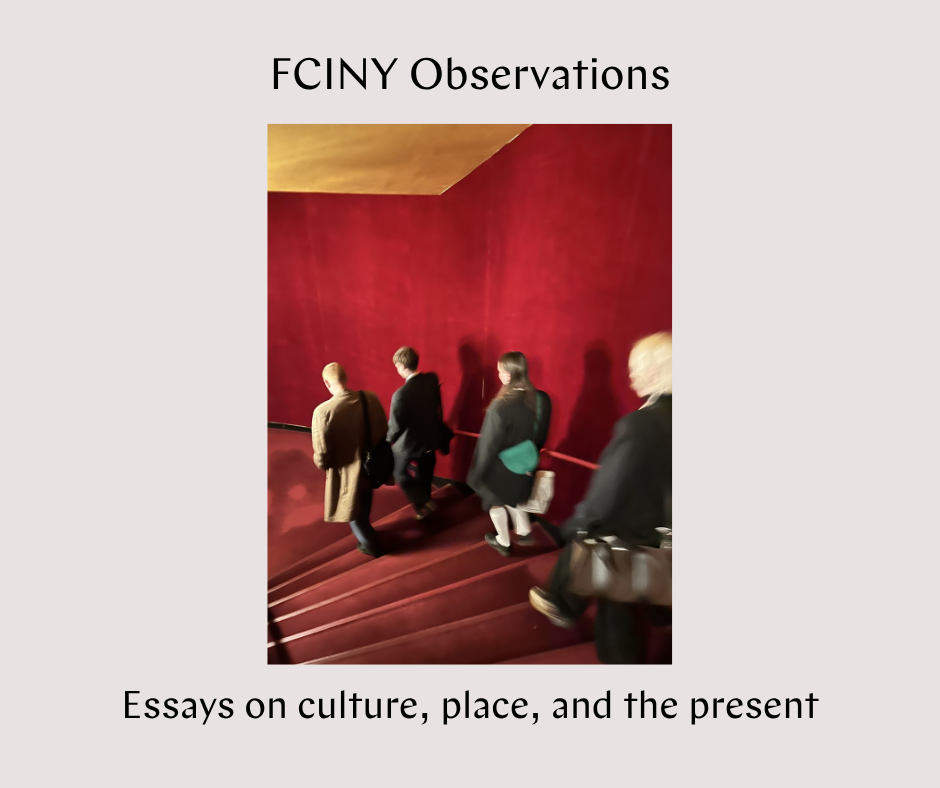
FCINY interns attended a performance of Innocence at the Metropolitan Opera during its opening week.
The Finnish Cultural Institute in New York's recurrent essay series, FCINY Observations, presents cultural commentary at the intersection of Finnish and New York perspectives.
Opera has been talked about strangely much recently. Rosalía released Lux, an album devoted to female saints and her search for light, led by a single called “Berghain” that became a genuine pop cultural moment by fusing the London Symphony Orchestra with operatic German and the dramatic staging of a mass.
Timothée Chalamet, in a filmed Q&A at the University of Texas, said he would not want to work in an art form where it feels like keeping something alive even though no one cares about it anymore, mentioning ballet and opera by name. The comment sparked a months-long cultural argument, with artists, critics, and Oscars hosts all weighing in. He was not entirely wrong.
What is up with opera?
Kaija Saariaho's final opera, Innocence, had its world premiere at the Festival d'Aix-en-Provence in 2021, and its Metropolitan Opera debut came on April 6, 2026, three years after the composer's passing. With that performance, Saariaho became the first female composer ever to have two operas staged at the Met.¹ The libretto is by Sofi Oksanen.
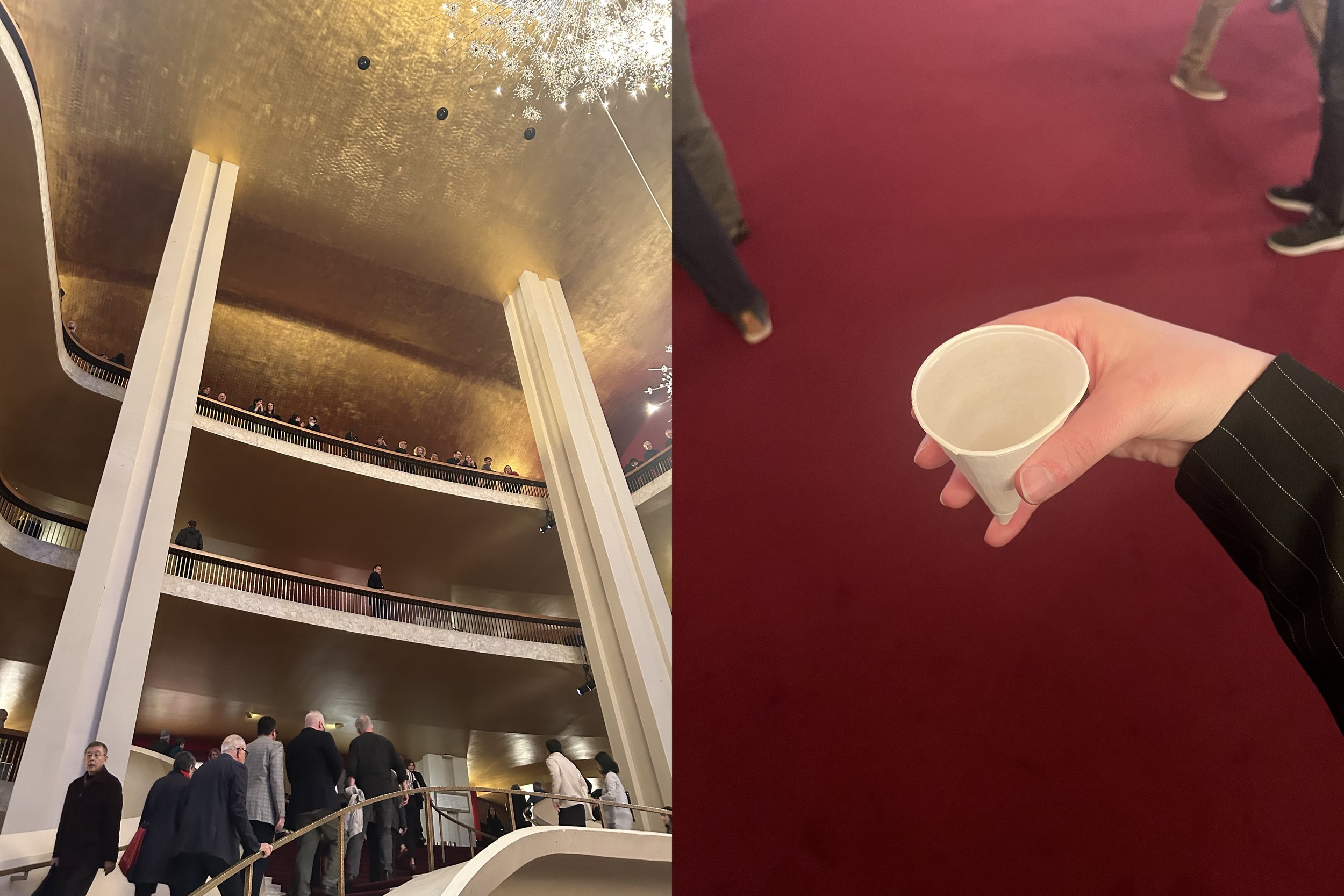
Grand opera and a water cone.
The opera's structure interweaves two storylines: a wedding in Helsinki ten years after the tragedy, and the tragedy itself, a shooting in an international school, narrated by the teacher and the students who speak directly to the audience, each in their own language. A rotating two-story set, designed by Chloe Lamford, allows the two timelines to shift between each other with fluid precision. The color palette is spectral, mid-century modern in its familiarity, ghostly in its effect. The uncanny comes from recognizing the ordinary. In the United States, the country leading in the frequency of school shootings, the story of Innocence lands differently.
According to the K-12 School Shooting Database, there have already been 63 school shootings this year, almost one every other day.² Kristoffer Borgli's A24 film The Drama, released just weeks before Innocence opened at the Met, had already unsettled audiences with its approach to the topic. In this fragile context, bringing a work by a Finnish composer, Finnish-Estonian librettists, a Finnish conductor, and Finnish singers to the stages of the world's most prominent opera house requires courage. Joyce DiDonato, who plays the mother of one of the victims, described her commitment to the production simply. It was the subject matter, and the importance of telling the story in America in 2026. She speaks of the hope that Innocence might do what she has seen opera do before, put cracks, as she says, in the hearts of people in a good way.³
A demonstration for the victims of school shootings was held outside Lincoln Center before the premiere — apparently independently, without the opera's involvement — and one critic wrote that he could not help but feel the political charge was being amplified on the stage.⁴ I would have welcomed a more deliberate step. Too often, the political agency of art is left to the audience alone and institutions are cautious about taking a stance. That could change. Innocence could have partnered with a gun violence prevention organization, transforming the production from an aesthetic confrontation into a political act with a direction.
Rosalía has taken opera's most seductive elements and made them pop. It is ambitious, but what does it do?
Opera does something that theater and film cannot. It slows time down. Feelings linger, get shapes and sounds that spoken words cannot hold. Where cinema turns away, opera stays. It lives inside a single moment long enough that the audience can no longer avoid its message. Part of how it does this is through repetition. In opera, a single phrase can be sung again and again, not because the composer ran out of ideas, but because the form insists that you sit with something until you actually feel it. It is closer to meditation than to storytelling. Innocence with its piercing eye for the tragic topic is not a performance you enjoy. It is a performance you do not leave the same.
In a time defined by short clips, quick cuts, and the skip button, that structure is unfashionable, even unbearable. Rebecca Humphries, writing in The Guardian, said it plainly: "Dwindling audience numbers post-Covid have led to significantly fewer stage shows being produced. It may be an awkward truth, but opera and ballet are going the way of stamp-collecting, churchgoing and blacksmithing, and appreciation alone will not rescue them. If as many people who've labelled Chalamet uncultured bought a ticket, opera and ballet wouldn't be in this mess. Clearly there's a difference between virtue signalling about art and doing what's required to keep it alive."⁵ Opera does not survive on reverence, only by staying relevant, by being willing to transform, and by giving audiences a reason to show up that goes beyond cultural obligation.
But the responsibility is not only the opera's. Self-discipline is one of the highest forms of engagement with the world, and dismissing opera for being demanding is lazy. We are better than that, and we know it. None of us should settle for being the armchair audience of our own culture. Innocence is not a performance you enjoy. It is a performance you do not leave the same.
To close this Observation, here is an upcoming productions in Helsinki that does exactly what opera should in this time:
The Sugar Factory
https://oopperabaletti.fi/en/repertoire/the-sugar-factory-2026/
If you have any other recommendations, please message us @thefciny or info@fciny.org
And if you ever get the chance to go see Innocence, take that chance!
Mimosa Tast
5.5.2026